

 Shipment Monitoring
 OnSite Monitoring
 Vehicle Monitoring
 Success Stories
 Biopharma
 Reproductive Medicine / IVF
 Animal Health
 Logistics
 Laboratories
 Cryogenic
 Dry Ice / ULT
 Cold Chain
 CRT
CRT Realtime Monitoring
 Wireless Monitoring
 Passive Monitoring
 Connected Shippers
 Tec4Cloud Platform
 Tec4Cloud Features
 Tec4App Mobile
 Calibration Services
 Control Tower
 24/7/365 Support
 Quality Management
 Airline Approvals
 Downloads
 Career
 Newsletter
Cryogenic Monitoring for Pharma and Life Sciences
Maintain full visibility and control of shipments and storage solutions at temperatures down to -196 °C
When it comes to ultra-low temperature logistics, Liquid Nitrogen (LN₂) is one of the most reliable cooling methods available. It is used in either Dry Vapor Shippers or Wet Liquid Shippers to achieve temperatures below -150 °C to -196°C.Send us a message!
Ensuring Safe Cryogenic Logistics with Real-Time Monitoring
Pharmaceuticals and bio samples are often deep-frozen, or stored at cryogenic temperatures, for preservation of efficacy, stability, shelf-life extension, specialized application, and other reasons. Cryogenic shipping and storing of pharmaceuticals is a critical process that requires careful handling to maintain the integrity and efficacy of temperature-sensitive medications, samples and vaccines.
Because of its extreme temperatures, cryogenic distribution presents higher risks, stricter regulatory requirements and more complex logistics.
When it comes to cryogenic distribution for the pharmaceutical industry, providers of temperature-controlled packaging, storage and shipping require next-level support across critical functions such as cold chain logistics planning and data monitoring. To ensure safe and legal transportation of cryopreserved materials, proper documentation, handling, temperature integrity and record-keeping are essential to meet regulatory standards.
With Tec4med, you can maintain safe cryogenic conditions in a controlled way and have access to real-time data for optimal supply chain visibility. The use of advanced monitoring systems and purpose-built condition monitoring devices help mitigate risks of temperature excursions, inadequate documentation, preventable delays and, ultimately, non-usable products.
Cryogenic Shipments and Storage

Cryogenic Shipments and Storage
Cryogenic
Cryogenic Shipments
with Dry Vapor or Liquid Nitrogen Dewars
Recommended Monitoring Devices
SmartTag MP for Real-Time Monitoring, CryoBeacon with LN₂ Probe
Data Readout
via Tec4App / SmartHub
Industries
Biopharma, Animal Health, IVF, CROs and Laboratories
Dry vapor vs. wet liquid shipping
Dry vapor shipping uses a cryogenic shipper that absorbs liquid nitrogen into a porous material. As the nitrogen slowly evaporates, it creates a cold vapor environment between −150 °C and −196 °C. Since no free liquid is present in the payload space, it’s safer for air transport, reduces spill risk, and simplifies regulatory compliance. It keeps samples cold for several days, making it ideal for advanced therapies and clinical logistics, though hold times are limited compared to full immersion.
Wet liquid shipping, by contrast, immerses samples directly in liquid nitrogen at −196 °C, the coldest possible condition. This offers unmatched thermal stability and is excellent for long-term or extremely sensitive materials. However, liquid nitrogen introduces spill hazards, stricter transport rules, and limitations for air cargo, so it’s more common in labs, cryogenic research, and industrial applications for storage than in global transport.
What we offer at Tec4med
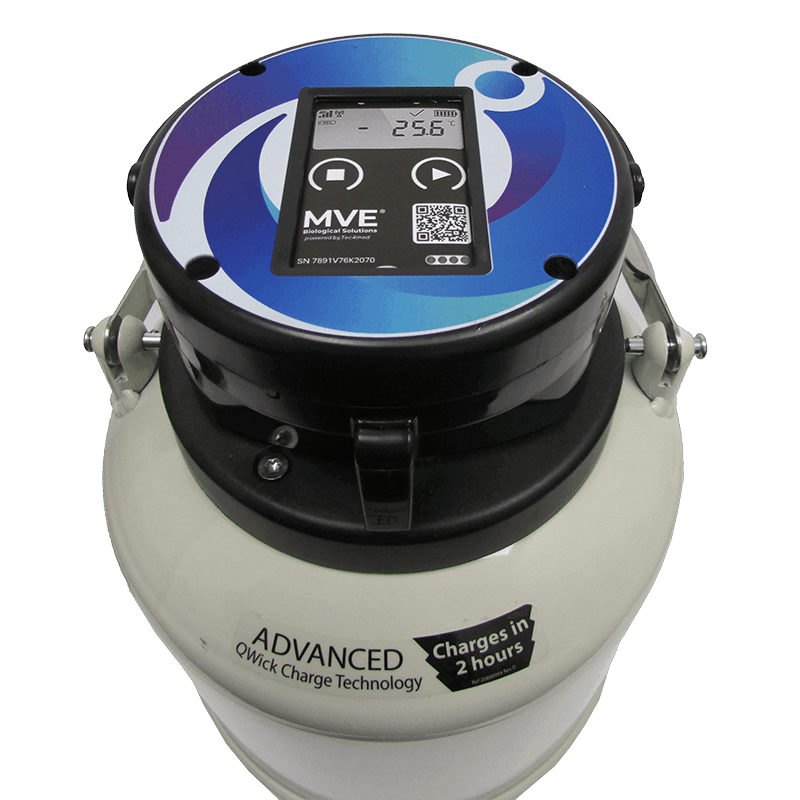
Our cryogenic data tracking & monitoring solutions offer a comprehensive way to address regulatory compliance for cryogenic distribution, including reusable cryo containers and shippers, sensors and devices for data recording, as well as Cloud-based software for monitoring and maintaining temperature ranges. They effectively provide full supply chain visibility and automate evaluation processes, preventing manual errors or inaccuracies for optimal audit trail and compliance management.
Our purpose-built wireless condition monitoring devices can withstand temperatures of −200°C, 100% rH humidity, and are pre-calibrated according to ISO17025 secure high standards.
Monitoring Critical Temperature Zones
Gamete & embryo cryopreservation: e.g. vitrified oocytes, cryopreserved embryos, sperm samples, ovarian tissue, testicular tissue
Fertility biobanking & long-term storage: e.g. donor egg/sperm bank inventories, fertility preservation samples for oncology patients, research embryos, stem cell lines derived from reproductive tissue
Reproductive tissue transport: e.g. inter-clinic embryo transfer, donor gamete shipment, reciprocal/cross-border IVF transport, egg and sperm bank distribution
Genetic testing & diagnostics: e.g. PGT-A/PGT-M embryo biopsies, karyotyping samples, carrier screening specimens, prenatal genetic testing samples
Reagents & culture media: e.g. cryoprotectant solutions, embryo culture media, vitrification/warming kits, enzymatic reagents for IVF labs
Biobanking & specimen transport: e.g. clinical trial specimens for reproductive research, tissue biopsies, DNA/RNA extraction samples, research-grade reproductive cell lines
Fertility medications & hormones: e.g. gonadotropins (FSH/LH), GnRH agonists/antagonists, hCG trigger medication, progesterone luteal support
Andrology & lab consumables: e.g. sperm wash media, IUI/IVF preparation reagents, semen analysis quality controls, cryoprotectant working stocks
Last-mile patient & clinic delivery: e.g. take-home stimulation medication kits, at-home hormone injections, courier delivery of fertility drugs to patients, clinic-to-clinic reagent restocking
Pharmaceutical products: e.g. temperature-sensitive tablets, capsules, injectables, specialty medicines, hospital pharmacy supplies
Clinical trial materials: e.g. investigational medicinal products, patient kits, comparator drugs, site-to-site trial supplies
Medical goods & healthcare products: e.g. temperature-sensitive medical devices, treatment kits, care supplies, hospital and clinic stock
Cryogenic Smart Monitoring Devices
Frequently Asked Questions About Tec4med's Expertise in
Cryogenic Real-Time Monitoring
Cryogenic shipping or storage refers to the transportation or storage of temperature-sensitive materials at extremely low temperatures, typically between -150°C and -196°C. It is commonly used for biological samples, cell and gene therapies, vaccines, reproductive medicine applications, and other critical pharmaceutical products that require ultra-low temperature conditions.
Our cryogenic monitoring solutions are designed for:
- Biopharmaceutical companies
- Animal health organizations
- IVF and reproductive medicine providers
- Contract Research Organizations (CROs)
- Research institutes and laboratories
- Clinical trial and advanced therapy logistics providers
Tec4med provides a comprehensive portfolio of cryogenic monitoring solutions, including:
- CryoBeacon with LN₂ probe for monitoring temperatures down to -196°C
- SmartTag MP for real-time shipment monitoring
- Tec4App and SmartHub for data access, analytics, and reporting
- Cloud-based monitoring and documentation platforms
- Reusable cryogenic containers and shipping solutions
Dry Vapor Shipping
Dry vapor shipping uses a cryogenic shipper that absorbs liquid nitrogen into a porous material. As the nitrogen gradually evaporates, it creates a temperature-controlled vapor environment between -150°C and -196°C.
Key benefits:
- No free liquid nitrogen in the payload chamber
- Lower spill risk
- Suitable for air transportation
- Easier regulatory compliance
- Safe and reliable for clinical and pharmaceutical logistics
Wet Liquid Shipping
Wet liquid shipping involves immersing samples directly in liquid nitrogen at -196°C.
Key benefits:
- Maximum thermal stability
- Ideal for highly sensitive materials
- Suitable for long-term storage applications
Considerations:
- Stricter transportation regulations
- Increased handling requirements
- Limited suitability for air transport due to liquid nitrogen hazards
Yes. With SmartTag MP and our connected monitoring platforms, stakeholders can access real-time shipment data, enabling greater supply chain visibility.
Tec4med's purpose-built wireless condition monitoring devices can operate at temperatures down to -200°C, making them suitable for even the most demanding cryogenic applications.
Automated monitoring systems help organizations:
- Reduce manual errors
- Improve documentation accuracy
- Detect temperature deviations immediately
- Increase supply chain visibility
- Protect valuable products and samples
- Simplify audit and compliance processes